 Farhan Arshad
Agentic AI
Agents do the work. I keep the send button.
Most of what gets sold as agentic AI is a chatbot with a to-do list. What I run is narrower and duller: a written process, an agent that executes it, connections to the tools the work lives in, and a person who reads the output before a client ever sees it. This page is what that looks like in a working agency, and where I think it breaks.
The stack
Three layers, and only one of them is the model
People argue about which model is best. In practice the model is the least interesting part. What decides whether an agent is useful is the process written above it and the reach given below it.
| Layer | What it is | What it fixes |
|---|---|---|
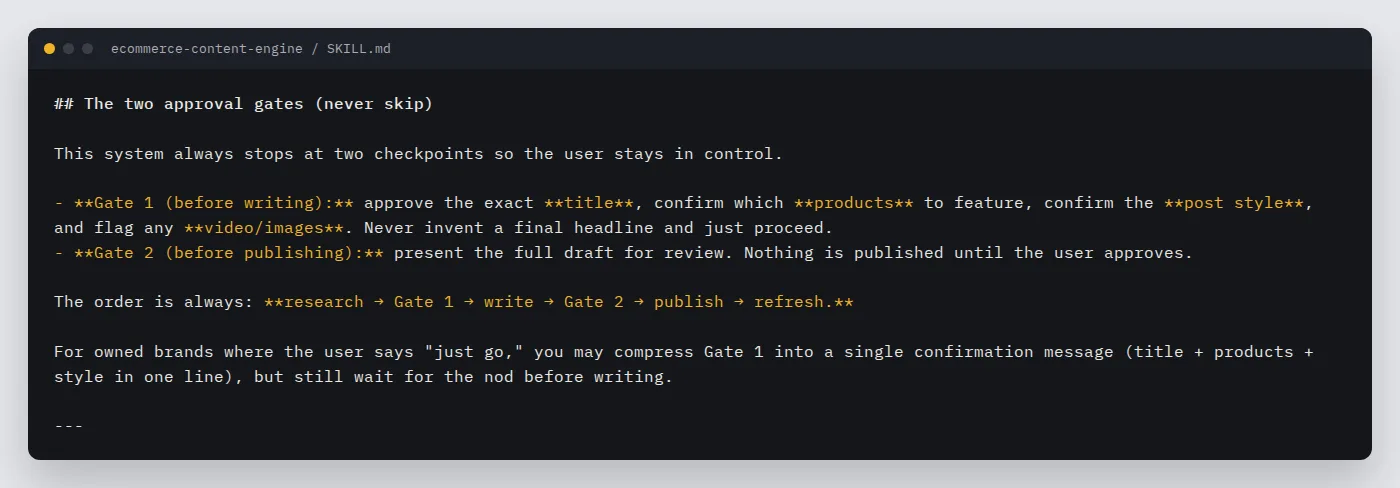
| 1. Skillsthe written process | A folder with the workflow, the rules, the approval gates and the output format. Thirty-five of them, listed on AI systems. Not prompts: files, versioned, that anyone on the team can open. | Output stops depending on who was typing. The same process runs whoever runs it. |
| 2. Agentsthe execution | Claude Code for builds and repeatable file work, Cowork for the team-facing tasks, and scheduled runs on n8n for anything that has to happen at 6am whether or not I am awake. | Work that used to wait for a human to start now arrives already drafted. The day begins with a draft, not a blank page. |
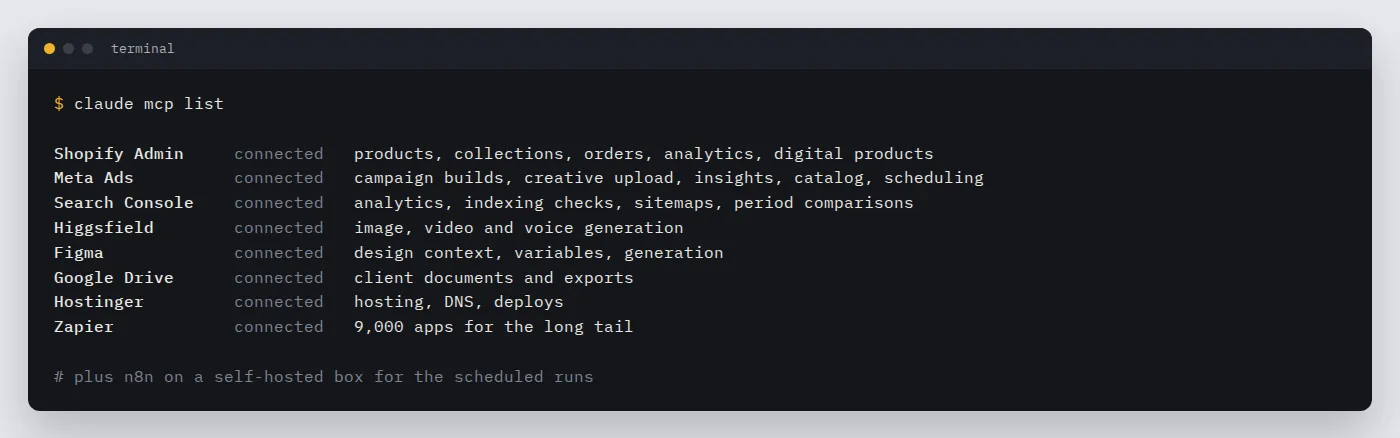
| 3. Connectionsthe reach | MCP connections to Shopify, Meta Ads, Search Console, Figma, Drive, Hostinger, Higgsfield and Zapier, so the agent reads the real account rather than a pasted screenshot. | No copy-paste step, so no stale numbers and nothing invented to fill a gap. |
A worked example
This website builds itself
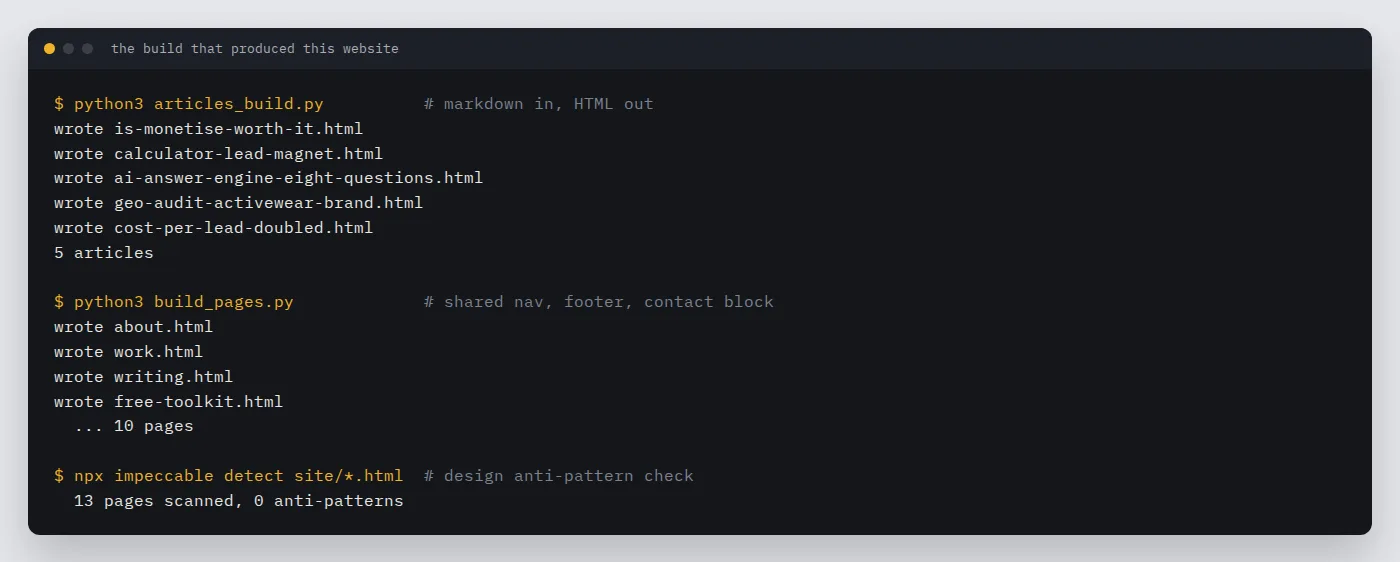
The site you are reading is the clearest example I can show, because you can check it. The articles are markdown files. A script renders them into pages with the shared nav, footer, schema and contact block. A design checker scans every page for anti-patterns before anything ships. I write the words and approve the result; the assembly is not my job any more.
That is the whole pattern, scaled down: a written process, an agent that runs it, a person who signs off. The same shape carries a client's monthly report and a store's content cycle.
Want this running on your own accounts?
A morning report on your ad account, a skill written for the job your team repeats most, or an honest look at whether an agent should touch it at all. Tell me what you are trying to do and I reply myself within one working day.
My views
What I believe after two years of running this
The bottleneck was never writing
Everyone automated the drafting first because it is the visible part. The expensive part of agency work is research, checking and the follow-up nobody schedules. Point the agent at those.
An agent with no process is a liability
Give a model a vague instruction and access to a client account and it will do something plausible and wrong. The file above it is what makes it safe, and writing that file is the actual skill.
Automation watches, people decide
Every system I run drafts, flags and proposes. None of them send. The first time an agent emails a client something wrong, you have spent trust you cannot buy back for a rounding error of saved time.
Model choice matters less than reach
A mid-tier model connected to the real ad account beats the best model guessing from a screenshot. Spend the effort on connections and context, not on the leaderboard.
Measure adoption, not capability
A skill nobody opens twice was wrong, no matter how clever the demo was. One team, one task, one skill, then check in a month whether it is still being used.
It is not free
The tooling runs roughly $20 to $100 a month plus whatever the ads cost. Anyone selling agentic AI as a zero-cost employee is selling something else.
Honest limits
Where I would not put an agent
Anything irreversible without a human in front of it. Sending, publishing, spending, deleting. The agent prepares it; a person presses it.
Judgement calls with thin evidence. An agent will happily diagnose a campaign from one week of data. Deciding whether a cost rise is creative fatigue or a broken audience needs someone who has seen both.
Relationships. The reason accounts stay is that a person noticed a problem and said so first. That is not a workflow, and pretending it is loses the client eventually.
Anything where a wrong number is expensive. Every skill I write forces the source to be fetched rather than recalled, because a model asked for a figure it does not have will produce one that looks right.
The short version
Write the process down, give the agent real access, let it draft everything, and never let it be the last pair of eyes. Everything else is detail. See the systems this runs on, or what it caught on a live ad account.
Contact
Say hello. I answer myself.
For a role, a consultation on AI search visibility, or an automation build. Tell me what you are trying to do and I will reply within one working day.
Or skip the form: WhatsApp me for a quick answer, or write to hello@farhanarshad.com if you would rather explain properly.